To be a pitcher named Hunter
- jagreens
- Aug 7, 2024
- 6 min read

If you’re a starting pitcher looking to allow less hard contact, here’s one simple trick that doctors hate: Make sure your first name is ‘Hunter.’
No starter has reduced his Hard Hit% by a greater margin than Hunter Brown, Houston’s 25-year-old right-hander. In dropping his Hard Hit% by 12.9%, Brown has turned into a dependable starter (4.11 ERA, 3.94 FIP in 21 GS) one year after posting a 5.09 ERA.
Right behind Brown, there’s Cincinnati’s flame-throwing All-Star, Hunter Greene. Greene’s 11.1% decline in Hard Hit% ranks third among qualified starters — behind Brown and Pittsburgh’s Luis L. Ortiz — helping key his development into one of the game’s best young arms.
Hard Hit% | Hunter Brown | Hunter Greene |
2023 | 44.4% (13th Percentile) | 33% (16th Percentile) |
2024 | 31.5% (92nd Percentile) | 44.1% (86th Percentile) |
Brown and Greene have evolved into two of the league’s best at mitigating hard contact, a year after being hit as hard as anyone. Let’s see how it happened.
Hunter Brown
Brown’s season can be divided into two parts. After a rough April (9.78 ERA in 6 GS), Brown has pitched to a 2.73 ERA over the last three months, emerging as a fixture in an Astros rotation ravaged by injury.
It’s not a coincidence that Brown’s success coincides with the genesis of his sinker.Brown threw seven sinkers total across his first two MLB seasons. He’s throwing his sinker 14.7% of the time this year, and that number is on the rise — in July, he threw it nearly a quarter of the time, making it his second-most-used pitch. He didn’t throw it once in April!
In particular, the sinker anchors Brown’s arsenal against right-handed hitters; facing RHB, Brown throws his sinker 30.8% of the time, more than his 4-seam fastball. Last month, sinkers accounted for nearly half of his pitches to RHB.
It’s not as if the sinker has been an incredibly successful pitch; RHB have a .350 wOBA against it (though the .318 xwOBA indicates a bit of bad luck). What’s important is the quality of contact that the sinker allows: it runs a 52.5% GB%, a meager 8.2% Hard Hit%, and a 75.1 MPH average EV. Against Brown’s sinker, RHBs essentially have Luis Arraez’s power, slugging .380.
Considering Brown’s pitch mix to RHB, it stands out like a sore thumb.
RHB against Brown in 2024, by pitch type | Pitch% | Hard Hit% |
Sinker | 30.8% | 8.2% |
4-Seam Fastball | 29.2% | 50% |
Cutter | 17.7% | 27.6% |
Slider | 10.4% | 60% |
Knuckle Curve | 9.5% | 41.7% |
The sinker is directly responsible for mitigating hard contact, but there’s a trickle-down effect at play here, too. Brown concentrates his sinker middle-in to RHB, which is where he often threw his 4-seam fastball last season. Now, though, he doesn’t have to worry about throwing his 4-seamer in, and can instead focus on using it where it’s most successful: at the top of the strike zone.

As such, Brown can follow what we’ll call the Verlander blueprint. Last year, FanGraphs summarized Verlander’s approach with his 4-seam fastball, saying: “Verlander leans heavily on a four-seam fastball that he uses up in the zone, so when batters miss, they tend to get under the ball.”
Slowly, we’re seeing Brown tinker with this, too.

Overall, Brown’s IFFB% is up to 13.9%, the 13th-highest mark among qualified pitchers and up significantly from his 2023 mark of 7.3%. Against RHB specifically, Brown is generating more swing-and-miss (nearly a 10% increase in Whiff%) and far more fly balls (44.1 FB%, up from 22.3% in 2023). Those numbers are not in Verlander’s stratosphere, and Brown still allows too many HR (15 total, including eight off the 4-seamer), in part why RHB are still hitting his 4-seamer (.355 wOBA). But it’s progress nonetheless, and progress made possible because of his sinker.
Brown’s also been more successful with his cutter, even though he’s throwing it less (-9.4%), because he’s doing a better job locating it. In concentrating it on the edge of the zone, the cutter is less likely to bleed into the heart of the plate. Sure enough, that’s made a difference, accounting for nearly a 400 point drop-off in SLG and a 15.8% reduction in Hard Hit% (43.4% to 27.6%).
Against LHB, Brown’s transformation is different, yet simpler. He doesn’t use the sinker — he’s thrown just 13 sinkers to LHB — instead relying on his changeup. It’s the profound, cunning process of using a successful pitch more often. Last year, LHB posted a .190 wOBA against Brown’s changeup, yet he threw it just 8.1% of the time. This year, in throwing it 22.1% of the time, the changeup has become Brown’s No. 2 option to LHB, and he’s maintained its success: LHB have a .245 wOBA and .245 SLG. It consistently generates a lot of swing-and-miss, too, with a 35% Whiff% each of the last two seasons.
In total, Brown still has room to get even better; namely, we recommend he continue to elevate his 4-seam fastball, so as to maximize his swing-and-miss. We’ve seen Brown take a step in this direction, but there are still additional rungs to climb, particularly right at the top of the strike zone — see if the hitter will chase.
And while he’s largely avoided throwing his 4-seamer inside to RHB — and for good reason — it’s worth re-exploring, eventually. Yes, the sinker has taken well to this role. But if Brown can locate his 4-seamer up and in, there are swing-and-miss capabilities there, too, which should only increase the effectiveness of his sinker, in what is a constant push-and-pull in order to best compliment the two pitches.
Hunter Greene
For Greene, it all comes down to location. The right-hander has always had a blazing fastball: As a rookie in 2022, he averaged 98.9 mph with his 4-seamer. But hitters saw it like a watermelon. This year, Greene has doubled down on his 4-seamer, throwing it more often to both RHB and LHB. Look at the discrepancies in Greene’s fastball this season, compared to his first two seasons in the majors.
Opposition vs. Greene’s 4-seam fastball | SLG | wOBA | Whiff% |
2024 | .267 | .259 | 25.2% |
2023 | .518 | .382 | 25.2% |
2022 | .514 | .374 | 28.3% |
It’s not as if Greene is generating more swings-and-misses — that has always been there. But when the opposition does make contact, they are not having nearly as much success.
We’ll start with left-handed hitters. Historically, LHB have had more trouble hitting Greene’s 4-seamer than RHB: They entered the year with a .350 wOBA and 30% Whiff%. This year, while the swing-and-miss is down (23%), so is the wOBA (.251).
Greene is primarily keeping his 4-seamer up and away to LHB, but in the strike zone: His 4-seam In Zone% to LHB is a career-high 55.8%. He’s thus forcing the opposition to go after it, even though it’s not an entirely hittable pitch. In turn, he’s generating more ground balls, limiting balls in the air. So while the Exit Velocity is comparable to prior seasons, it manifests itself in the sort of contact less likely to cause damage.
GB%: 14.7% → 35.5%
LD%: 32% → 16%
Hard Hit%: 46.7% → 45.2%
Barrel%: 9.3% → 5.4%
EV: 91.5 MPH → 90.7 MPH
What does it all look like? Well, some pretty ugly swings.
Right-handed hitters have always given Greene more trouble. Last season, they posted a .586 SLG and .413 wOBA, with a meager 19.9 Whiff%, against Greene’s fastball. Basically, they put up Juan Soto-level statistics.
In one year, they’ve gone from Soto to, well, Ke’Bryan Hayes, who has the lowest SLG of any qualified hitter: This year, RHB have a .268 SLG, .268 wOBA and 27.4% Whiff% against Greene’s 4-seamer.
Greene’s success with RHB is borne in the opposite fashion as his success against LHB. He’s generating more contact in the air, but it’s far softer, and thus less harmful.
Hard Hit%: 52.6% → 33.3%
Barrel%: 12.4% → 4.8%
EV: 91.1 MPH → 88 MPH
As a whole, his IFFB% is up from 6.6% to 16.3%, a change that has much to do with how he’s deploying his 4-seamer to RHB.
The location is key here. Last year, his 4-seamer was a bit all over the place, predominantly missing over the middle of the plate and up, theoretically right where a hitter likes it. Now, it’s clustered on the edge of the strike zone, away from the hitter — just as he does with LHB, Greene wants to keep the 4-seamer away from the hitter’s bat path. If we look at Game Day Zone 6, hitters are slugging .267 against 4-seamers in this quadrant in 2024. His plan has been consistent — from his first start of the year to his most recent.

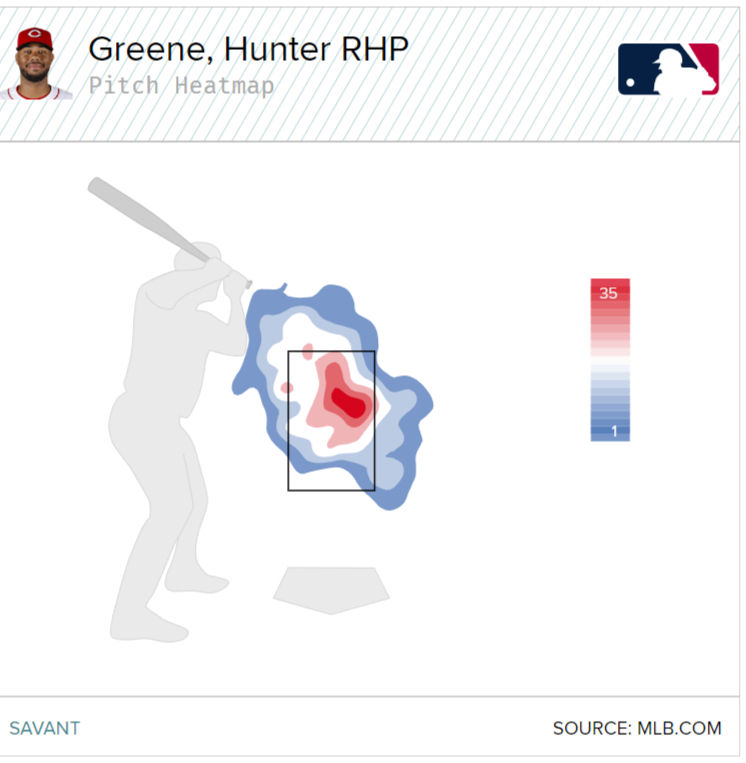
Location was always going to be paramount for Greene, because while his 4-seamer has near-unparalleled velocity, it lacks other pitch shape characteristics that reduce hitability. His 4-seamer has a generic amount of vertical movement — 4% more than comparable 4-seamers — and below-average extension, so there’s no illusion of rise, rendering it as flat. As a result, with decent horizontal movement but little vertical movement, the pitch was
susceptible to zagging into the hitter’s bat path. Hence, we see Greene keeping his 4-seamer away from both LHB and RHB, and finding great success in doing so. When he has pinpoint command, throwing it at 99 mph in spots that are more conducive to him, well, you get what you’re seeing now.
If we’re being picky, Greene could seek to recover some of those swings-and-misses against LHB. Perhaps he can experiment with the Verlander blueprint, too, elevating it not only up in the strike zone, but out of the strike zone entirely. See if the hitter will bite — and we have reason to believe that they will, because they did in these spots a year ago. For the meantime, pounding the zone is a trade-off Greene will happily accept.
Comments