Reese Olson is spinning a lethal slider
- jagreens
- Feb 8, 2025
- 6 min read

The Tigers are poised to enter 2025 with a traditional five-man rotation, bidding adieu to their ‘pitching chaos,’ which spurred an improbable postseason berth. It’s a transition made possible by healthy arms like Reese Olson, a 25-year-old left-handed who followed a promising rookie season (4.01 FIP) with a strong, 22-start sophomore campaign (3.17 FIP)
Among the improvements that Olson made from 2023 to 2024, his worst pitch — a slow, heavy slider — became his best pitch. Olson’s slider actually cost him runs in 2023 (-2 RV). But in 2024, on an RV/100 basis, it was the 10th-most valuable slider in baseball (1.6), among pitchers who threw at least 400 sliders. And I think there’s a lot of untapped potential heading into 2025, too.
Let’s start with what Olson did right: His slider became even better against left-handed hitters.
Olson's Slider vs. LHB
wOBA | xwOBA | Whiff% | |
2023 | .319 | .330 | 34.4% |
2024 | .263 | .302 | 41.7% |
Sliders are a platoon-based pitch, typically worse against opposite-sided hitters because of their glove side movement, which often leads directly into the barrel. And while Olson’s slider eats up RHB, it’s stingy versus LHB, too: Only Dylan Cease, Logan Gilbert, and Hunter Greene posted a lower wOBA with their slider against LHB (min. 250 sliders thrown) than Olson’s .263 wOBA.
The success of Olson’s slider against left-handed hitters can be explained in part by its spin. Statcast’s spin axis data shows us that Olson’s slider is moving one way out of his hand, and by the time it arrives at the plate, the path of the pitch has deviated — behaving like it was released on a different axis. On a clock face, we see that Olson’s slider shifted downwards, on average, from 9:00 to 8:00, according to Baseball Savant. In 2023, meanwhile, Olson spun his slider on an 8:30 axis.

I don’t know if Olson changed his slider grip — he did modify his release point, which was 0.1 in. higher and 0.2 in. closer to first base. But to change his axis, Olson likely had to rip off the side of the baseball, which also meant sacrificing spin efficiency, in this case with a 10% reduction in Active Spin. So, just 32% of Olson’s total spin contributed to the slider’s movement, which impacted its movement profile: It decreased the horizontal movement from 7.8 in. of sweep to 5.6 in. of sweep, while reducing the pitch’s drop by 0.8 in.
In return, Olson had a greater axis deviation (60), creating an extra layer of deception. His slider is increasingly incongruent from what a hitter expects, based on its spin release.
This is a phenomenon that the Tigers have embraced before. Tarik Skubal crafted his sterling changeup using seam-shifted wake, as he explained to MLB.com’s David Adler last April:
“Say I release it on one axis — the seam effects actually make it behave like it’s on a different axis,” Skubal said, before demonstrating two different changeup grips. “So, you’re getting the shape of a pitch that you’d be throwing by releasing it here, but you’re actually releasing it here.”
Olson’s new axis of rotation suggests that spin should not deflect his slider down, but that’s exactly what happens. And thus, Olson generates plenty of swings like this:

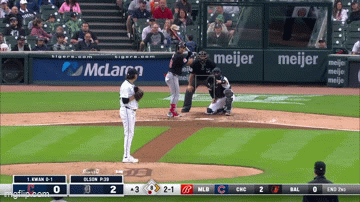
Pitches with a positive axis deviation have more movement down and to the arm side than expected, each of which profiles well against opposite-sided hitters. Their muscle memory tells them that a slider released with that spin shouldn’t dive, and it’s why they have trouble hitting it — let alone making any sort of impactful contact. Both Devers and Kwan swing over the top of Olson’s slider and, in Devers’s case, it’s one that catches a lot of plate. We can see the optical illusion of ‘late’ drop help it dip underneath the bat.
Movement is a lot about not being average, and for Olson’s slider, outlier vertical movement is key. And even though Olson’s slider dropped less in 2024 (-2.2 IVB) than it did in 2023 (-2.9 IVB), the movement is more impactful. Hitters are expecting the behavior of a slider released on a 9:00 axis, not an 8:00 one. This helps explain the surge in whiffs, with Olson’s slider generating more swing-and-miss to hitters from both sides of the plate in 2024 compared to 2023.
You’ll also notice that in both of the above clips, Olson is throwing his slider in a hitter’s count. That may feel abnormal, but for Olson, it’s not: Only 14 RHP threw more sliders to LHB in hitter’s counts than Olson did in 2024. It marked a pretty substantial change from how he deployed the pitch in 2023, too.
Olson’s pitch usage to LHB, by count
Sliders | Olson’s Ahead | Olson’s Behind |
2023 | 23.1% | 27.7% |
2024 | 14.7% | 33.6% |
When Olson jumped ahead of a LHB, he placed his slider on the backburner, as a distant third option. But when he fell behind, it was his clear No. 2 choice, trailing only the four-seamer.
Sure enough, Olson also found atypical success in these counts. His slider ran the 10th-highest whiff rate of any slider in MLB when thrown behind in the count, at 46.7%. I see this as a direct result of his spin, with the axis deviation affording him to use his slider in dangerous counts. Throw in the count-based oddity, and the more deception, the better.
In terms of the improvements that Olson can make in 2025, we switch our focus to right-handed batters.
When right-handed hitters make contact with Olson’s slider, they can’t do much with it. They hit just .085 with a .175 wOBA and .225 xwOBA against the pitch in 2024. Only four pitchers generated a lower wOBA with their slider against RHB, among pitchers who threw at least 240 sliders.
Yet Olson didn’t maximize that skill, because a lot of his sliders looked like this:

That’s an easy take, even for the free-swinging Sal Perez. Unfortunately for Olson, he threw more uncompetitive sliders in 2024 than he did in 2023. As a result, he generated fewer swings, mitigating the slider’s skill of inducing weak contact.
Olson’s uncompetitive slider
vs. RHB | Chase/Waste | Swing | Contact | SwStr | Putaway |
2023 | 39.3% | 50.8% | 28.2% | 23.2% | 24.3% |
2024 | 46.6% | 42.6% | 20.9% | 21.7% | 18.6% |
That’s not to say that Olson should seek contact with his slider. Rather, the slider’s ability to suppress damage allows him to be a little more aggressive, especially once he’s gotten ahead of the hitter. There’s no viable reason for the slider to be a worse putaway pitch (18.6%) than his four-seamer (18.8%).
When I first started investigating Olson’s slider, I assumed that hitters were having a tough time laying off the pitch once they fell behind in the count. Turns out, the opposite is happening; those are the easy takes. That speaks overtly to the uncompetitiveness of Olson’s sliders, which come out of his hand as a ball. Better location — say, more in Statcast’s ‘Chase’ zone than the ‘Waste,’ or closer to ‘Shadow’ — should lead to more success, just in terms of being hittable. Or perhaps the more apt term would be swingable, prompting whiffs as well as contact.

It’s not all bad news: The above heatmaps, courtesy of FanGraphs, show the location of Olson’s sliders to RHB in 2023 (left) and 2024 (right). Olson eliminated the unfortunate cluster of sliders over the plate, and he knows where he wants to throw his slider, off the plate to RHB. But there’s too much variance here, especially away from the strike zone.

This affected the way Olson deployed his slider to RHB, too. For one, he used it 4% less often than he did in 2023, a drop-off that stemmed from an unwillingness to use it when he jumped ahead in the count. He actually used his sinker (33.3%) more often than his slider (33.2%) in advantageous counts, which is antithetical: A sinker is designed to limit barrels, not to secure strike two or three. That screams slider. Sure enough, this plan had flaws — the sinker generated a .355 wOBA in these counts, whereas the slider had just a .080 wOBA. But Olson saw RHB stop swinging, and chasing, at his slider, and so he opted for something else. Come 2025, the attack plan should be to throw more competitive sliders in these spots. More of this, please:

I’m excited to see how Olson’s slider continues to evolve in 2025, as a vital piece to his arsenal. He unlocked another level using spin-based deception to quell left-handers last year, and he has the tools to dominate right-handers — so long as he stops giving them an easy out with non-competitive pitches.
Comments